
What Are Leaded Brass Fittings?
Leaded brass fittings are made from a copper‑zinc alloy that contains a specific percentage of lead, typically between 2% and 4% by weight . The lead is intentionally added during manufacturing to improve the material's machining properties.
The most common leaded brass for fittings is C36000 (Free‑Cutting Brass) , which contains approximately 60–63% copper, 35–37% zinc, and 2.5–3.7% lead . This alloy has excellent chip‑breaking characteristics during high‑speed machining.
Key properties of leaded brass fittings:
| Property | Typical Value |
|---|---|
| Tensile strength | 300–500 MPa |
| Machinability rating | 80–100% (vs. 100% for free‑cutting steel) |
| Lead content | 1.6% – 4.0% |
| Melting point | 1650–1710°F (899–932°C) |
Leaded brass also offers good corrosion resistance and strength. However, because of its lead content, its use is increasingly restricted in applications involving drinking water, food processing, and children's products .
What Are Lead‑Free Brass Fittings?
Lead‑free brass fittings are made from alloys that either contain no intentionally added lead or have a lead content below 0.25% by weight. To achieve good machinability without lead, manufacturers substitute lead with other elements such as silicon, bismuth, or phosphorus .
The legal definition of "lead‑free" varies by region:
United States (NSF/ANSI 372): Less than 0.25% lead by weighted average
Europe (EU Drinking Water Directive): Leaching limits, not a fixed percentage
New Zealand (Building Code G12/AS1): 0.25% lead limit effective May 2026
Common lead‑free brass alloys include:
C87850 (Silicon Brass): Contains silicon instead of lead
C89833 (Bismuth Brass): Uses bismuth as a lead substitute
CW617N (European lead‑free brass): ≤0.25% lead, used for pipe fittings
Key properties of lead‑free brass fittings:
| Property | Typical Value |
|---|---|
| Lead content | ≤0.25% (often <0.1%) |
| Machinability | Good (slightly lower than leaded) |
| Corrosion resistance | Excellent (often better than leaded) |
| Tensile strength | Comparable to leaded brass |
The Critical Difference: Machinability
The primary advantage of leaded brass fittings is superior machinability. The lead acts as a built‑in lubricant during cutting and drilling. It creates small, well‑formed chips that do not clog cutting tools, allowing for:
Faster production speeds
Longer tool life
Smoother surface finishes
Tighter dimensional tolerances
Leaded brass has a machinability rating of 80–100% compared to free‑cutting steel. Lead‑free brass typically has a machinability rating of 60–80%, requiring slower cutting speeds and more frequent tool changes .
This difference is critical for manufacturers producing large volumes of complex parts such as valves, threaded connectors, and precision fittings.
Environmental and Health Regulations
The use of leaded brass fittings is increasingly restricted due to health and environmental concerns. Lead is a toxic heavy metal that can leach into drinking water, posing risks to human health, particularly for children and pregnant women .
Key regulatory milestones:
| Year | Regulation | Requirement |
|---|---|---|
| 2014 | U.S. Safe Drinking Water Act | Lead content ≤0.25% for plumbing components |
| 2024 | NSF/ANSI 61 Annex N‑2 | Seven lead‑free brass alloys added to Acceptable Materials list |
| 2026 | New Zealand Building Code | 0.25% lead limit effective May 1, 2026 |
Leaded brass is still permitted for non‑potable applications. These include:
Industrial valves and fittings
Automotive components
Lock mechanisms
Architectural hardware
Lead‑free brass is required for:
Potable (drinking) water systems
Food processing equipment
Medical devices
Children's toys
Corrosion Resistance: Lead‑Free Is Often Better
Contrary to what many assume, lead‑free brass fittings generally offer superior corrosion resistance compared to leaded brass.
A 2019 study compared lead‑free bismuth and silicon brasses against traditional leaded brasses in corrosive water conditions . The findings showed:
Lead‑free alloys C87850 and C89833 demonstrated similar or better corrosion‑resistant potential than traditional corrosion‑resistant brasses
In field tests, bismuth and silicon brass water meters showed no dezincification, while yellow brass (leaded) exhibited dezincification concordant with water conditions
Dezincification is a form of corrosion where zinc selectively leaches out of brass, leaving a weak, porous copper structure. The silicon in lead‑free silicon brass inhibits this process, making it more durable in aggressive water conditions .
Comparison of corrosion resistance:
| Property | Leaded Brass | Lead‑Free Brass |
|---|---|---|
| Dezincification resistance | Moderate – depends on alloy | Excellent (silicon/bismuth grades) |
| Saltwater resistance | Poor (dezincification risk) | Good (naval lead‑free grades) |
| Acidic water resistance | Moderate | Good to excellent |
For marine or coastal applications, lead‑free naval brass C46400 (containing tin for dezincification resistance) is often preferred over standard leaded brass .
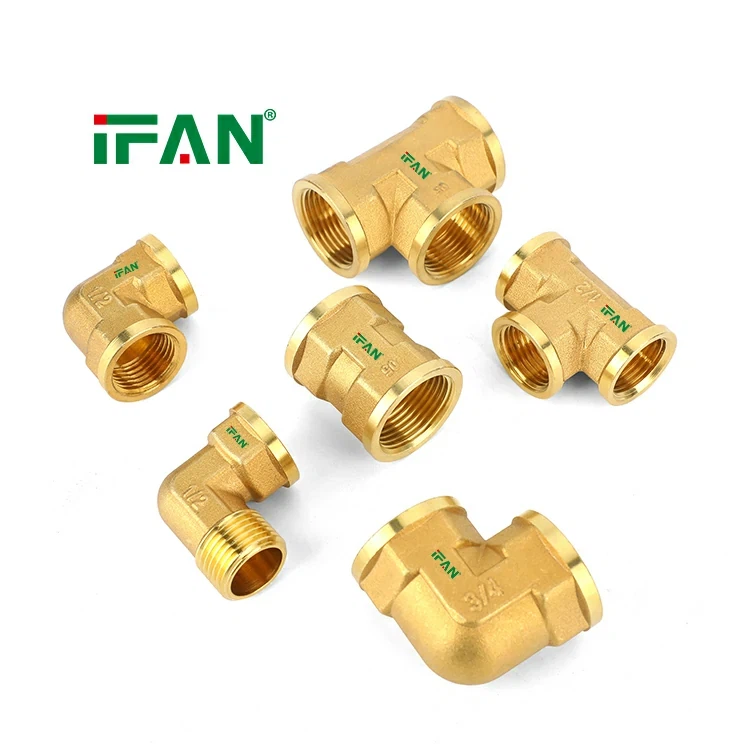
Applications for Each Type
Leaded Brass Fittings Are Best For:
Industrial machinery and hydraulics – where high machinability is needed and potable water contact is absent
Oil and gas systems – where lead content is not regulated
Automotive components – bearings, bushings, and valve stems
Architectural hardware – locks, hinges, and decorative trim
Lead‑Free Brass Fittings Are Required For:
Drinking water plumbing – residential and commercial potable systems
Food and beverage processing – equipment and piping
Medical gas systems – oxygen and other medical gases
Water meters and backflow preventers – direct contact with drinking water
Recent Developments: NSF/ANSI 61 Annex N‑2
In 2024, the Copper Development Association (CDA) announced that seven lead‑free brass alloys were added to the NSF/ANSI/CAN 61 Acceptable Materials list . This is the first expansion of this list in over 20 years.
What this means for manufacturers:
Products made from these certified alloys are now exempt from recurring NSF 61 leaching testing. This significantly reduces compliance costs and simplifies certification for lead‑free brass fittings.
The alloys were approved after extensive testing and approval by the NSF Joint Committee and the NSF Public Health Council.
How to Identify Each Type
Identifying leaded vs. lead‑free brass fittings:
| Clue | Leaded Brass | Lead‑Free Brass |
|---|---|---|
| Color | Slightly warmer yellow | Brighter, cooler yellow |
| Markings | Often unmarked or generic | "NSF 61," "LF," or "Lead‑Free" stamped |
| Price | Lower | Higher (15–30% premium) |
| Magnetism | Non‑magnetic | Non‑magnetic |
Always look for certification markings. Genuine lead‑free brass fittings will bear marks such as "NSF/ANSI 372" or "LF" .
Cost Comparison
Leaded brass fittings are generally less expensive because:
Raw materials (copper, zinc, lead) are cheaper
Manufacturing (machining) is faster and easier
Longer tool life reduces production costs
Lead‑free brass fittings command a 15–30% price premium due to:
More expensive alloying elements (silicon, bismuth)
Lower machining speeds (shorter tool life)
Tighter quality control for certification
However, for potable water applications, the added cost is necessary for code compliance and public health safety .
Summary Table
| Feature | Leaded Brass Fittings | Lead‑Free Brass Fittings |
|---|---|---|
| Lead content | 1.6 – 4.0% | ≤0.25% |
| Machinability | Excellent (80–100%) | Good (60–80%) |
| Cost | Lower | Higher (15–30%) |
| Corrosion resistance | Good (dezincification risk) | Excellent (silicon/bismuth grades) |
| Potable water approved | No (generally restricted) | Yes (NSF/ANSI 61) |
| Primary applications | Industrial, automotive, locks | Plumbing, drinking water, medical |
| Certification markings | Rarely marked | "NSF 61," "LF," "Lead‑Free" |
Leaded brass fittings offer superior machinability and lower cost, making them ideal for industrial and non‑potable applications. Lead‑free brass fittings are required for drinking water systems, offer better corrosion resistance, and comply with modern health and environmental regulations. For any plumbing application involving potable water, lead‑free brass is the only legal and safe choice. For industrial or mechanical applications where water contact is not a concern, leaded brass remains a cost‑effective option.