
Why Choose Us?
Advanced Equipment
German process equipment, each production line adopts the unified German process production standard, in line with SGS, BV and other quality management certification, standardized assembly and packaging, 27-person quality control team, 24-hour escort for product quality.
Rich Experience
IFAN factory started in 1993. And IFAN has workshop 120000 ㎡with 610 staff. In the past 30 Years, IFAN has never forgotten his mission-To protect health and safety.
Complete Range Of Products
IFAN can design and produce all plumbing pipe and fitting include PPR,PVC,CPVC PPSU HDPE PEXA PEXB PERT pipe and fitting ,brass fitting, brass ball valve ,heating system , gas system , sanitary faucets and hose.
High Quality Products
IFAN factory use best materials to produce high quality pipe and fittings with automatic production line and high tech quality control machines. The most important,IFAN can guarantee that all pipes and fittings manufactured by IFAN are qualified.
What Is Plastic Fitting
Plastic fittings made of ABS, PVC, and CPVC-CTS include a range of tees, adapters, elbows, crosses, couplings, bushings, caps, plugs, traps, and unions. The plastic materials are suitable for a variety of applications including DWV, hot and cold water pressure distribution systems, pool and spa, and irrigation.
-

PPR Manufacturer Free Sample Low Price PPR Pipe Fitting
Type:PPR Pipe Fittings. Color:Green/White/Blue/Gray/Yellow/Black Or Customized. Brand:IFAN/IFANPLUS/OEM/No Brand. Connecting method:Welding. Applications:Hot & Cold water. Experience;30+years. Add to Inquiry -
High-Quality PPR Pipe Fittings For Plumbing Applications
Type:PPR Pipe Fittings. Color:Green/White/Blue/Gray/Yellow/Black Or Customized. Brand:IFAN/IFANPLUS/OEM/No Brand. Connecting method:Welding. Applications:Hot & Cold water. Experience;30+years. Add to Inquiry -
Durable PPR Pipe Fittings For Water Supply Projects
Type:PPR Pipe Fittings. Color:Green/White/Blue/Gray/Yellow/Black Or Customized. Brand:IFAN/IFANPLUS/OEM/No Brand. Connecting method:Welding. Applications:Hot & Cold water. Experience;30+years. Add to Inquiry -
PPR Pipe Fittings For Residential Use
Type:PPR Pipe Fittings. Color:Green/White/Blue/Gray/Yellow/Black Or Customized. Brand:IFAN/IFANPLUS/OEM/No Brand. Connecting method:Welding. Applications:Hot & Cold water. Experience;30+years. Add to Inquiry -
PPR Pipe Fittings Fast Delivery
Type:PPR Pipe Fittings. Color:Green/White/Blue/Gray/Yellow/Black Or Customized. Brand:IFAN/IFANPLUS/OEM/No Brand. Connecting method:Welding. Applications:Hot & Cold water. Experience;30+years. Add to Inquiry -
OEM PPR Pipe Fittings Supplier
Type:PPR Pipe Fittings. Color:Green/White/Blue/Gray/Yellow/Black Or Customized. Brand:IFAN/IFANPLUS/OEM/No Brand. Connecting method:Welding. Applications:Hot & Cold water. Experience;30+years. Add to Inquiry -
PPR Plumbing Pipe Fittings
Type:PPR Pipe Fittings. Color:Green/White/Blue/Gray/Yellow/Black Or Customized. Brand:IFAN/IFANPLUS/OEM/No Brand. Connecting method:Welding. Applications:Hot & Cold water. Experience;30+years. Add to Inquiry -
PPR Pipe Fittings With Best Price
Type:PPR Pipe Fittings. Color:Green/White/Blue/Gray/Yellow/Black Or Customized. Brand:IFAN/IFANPLUS/OEM/No Brand. Connecting method:Welding. Applications:Hot & Cold water. Experience;30+years. Add to Inquiry -
PPR Pipe Fittings OEM Service
Type:PPR Pipe Fittings. Color:Green/White/Blue/Gray/Yellow/Black Or Customized. Brand:IFAN/IFANPLUS/OEM/No Brand. Connecting method:Welding. Applications:Hot & Cold water. Experience;30+years. Add to Inquiry -
PPR Pipe Fittings Manufacturer
Type:PPR Pipe Fittings. Color:Green/White/Blue/Gray/Yellow/Black Or Customized. Brand:IFAN/IFANPLUS/OEM/No Brand. Connecting method:Welding. Applications:Hot & Cold water. Experience;30+years. Add to Inquiry -
Wholesale PPR Pipe Fittings
Type:PPR Pipe Fittings. Color:Green/White/Blue/Gray/Yellow/Black Or Customized. Brand:IFAN/IFANPLUS/OEM/No Brand. Connecting method:Welding. Applications:Hot & Cold water. Experience;30+years. Add to Inquiry -
PPR Pipe Fittings For Water Supply
Type:PPR Pipe Fittings. Color:Green/White/Blue/Gray/Yellow/Black Or Customized. Brand:IFAN/IFANPLUS/OEM/No Brand. Connecting method:Welding. Applications:Hot & Cold water. Experience;30+years. Add to Inquiry


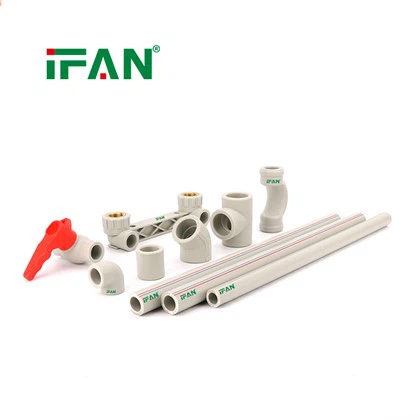


Plastic Fittings Types & Their Functions
Elbows: Such plastic fittings are used to change the direction of the flow. Elbows.They are majorly available in two standard types - 90 and 45 degree angles owing to their high demand in plumbing. The 90 degree elbow is primarily used to connect hoses to water pumps, valves, and deck drains, while the 45 degree elbow is mostly used in water supply facilities, electronic and chemical industrial pipeline networks, food, air-conditioning pipelines, garden production, agriculture, and solar-energy facility.
Couplings: A coupling is a plastic fitting used to stop leakages couplings in broken or damaged pipes. The pipes to be connected should be of the same diameter. The two kinds of couplings used in plumbing are regular coupling and slip coupling. The regular coupling is arranged between the two pipes to prevent further leakages with the help of rubber seals or gaskets on the both sides. The slip coupling itself contains two pipes to repair the damaged lengthy pipes.
Union: This type of plastic fitting is almost similar union to coupling in terms of functions, but just with a difference, i.e. a union can be removed easily any time while the coupling cannot. A variety of dielectric unions are used to join pipes made of different materials to avoid any kind of galvanic corrosion between them. These plastic fittings comprise of a nut, female and male ended threads.
Adapters: Adapters are connected to pipes to either increase their adapters lengths or if pipes do not have appropriate ends. These plastic fittings make the ends of the pipe either male or female threaded as per the need. This permits unlike pipes to be connected without any need of extensive setup. They are mostly used for PVC and copper pipes.
Nipple: This is a short butt of a pipe that works as a connection nipple between two other fittings having male threads. A close nipple is a type of plastic fitting having continuous threading on them. They are mostly used in hoses and plumbing.
Reducer: This pipe setting is used to reduce the flow size of the pipe from the bigger to smaller one. There are two kinds of reducers- concentric reducer and eccentric reducer. The former one is in the shape of a cone used for gradual reducing of the size of the pipe. The latter one has its one edge facing the mouth of the connecting pipe reducing the chances of air accumulation.
Tee: This T-shaped plastic fitting used in the plumbing tee system has one inlet and two outlets arranged at an angle of 90 degrees to the main pipe. This kind of fitting is used to connect the two pipes and make their flow direction as one. If all the three sides of this fitting are same in size, it is called equal tee, otherwise unequal tee.
Cross: This type of plastic fitting contains cross four openings in all the four major directions. This fitting is adjoined to four pipes meeting at common point. There is either one inlet and three outlets or vice-versa to flow water or any other liquid in four different directions. These kinds of plastic fittings are commonly used in fire sprinkler systems.
Flanges: A flange is another plastic fitting used to connect pipes, Flanges pumps, valves, and other components to form a full-fledged piping system. They come with a flexibility of easily cleaning or inspecting the whole system from within. They are fixed to the pipes using welding, threading or screwing techniques and then finally sealed with the help of bolts. They are used in residential pump systems and majorly for industrial purposes.
Caps & Plugs: Both these plastic fittings are used to close the ends Caps & Plugs of the pipe either temporarily or permanently. The plugs are fitted inside the pipe and threaded to keep the pipe for future use. There are a good number of ways a cap can be applied to the pipe like soldering, glue, or threading depending on the material of the pipe.
Bushings: These plastic fittings are used to combine pipes of different. Bushings sizes together by decreasing the size of the larger fitting to the size of the smaller pipe. Bushings are not always threaded inside out and occupy very little space in comparison to a union or coupling used for the same purpose.
Wyes: Such type of plastic fittings are used in drainage systems and have wyes a branch line at 45 degrees to keep the flow of water smooth. When the sanitary tees fail to work in a horizontal connection, such cases needs a wye.
Valves: Valves are used in the plumbing system to stop Valves the flow of gases or liquids. There are of three types – throttling, isolation, and non-return. The isolation valves are used to disconnect a part of the piping system temporarily for maintenance or repair. The throttling valves are used to regulate the amount of pressure of a liquid in a pipe; they can also withstand the stress caused by this process.
Barb: Barb A barb is another useful plastic fitting used in the plumbing system that connects flexible tubing to pipes. It has a male-threaded end on one side that connects with the female threads, and the other end has a single or a multi-barbed tube that is inserted in the flexible tubing.
Diverter Tee: This kind of a tee-shaped plastic fitting is commonly used in the pressurized hydronic heating systems to redirect a part of the flow from the main line to the side branch connected to a heat exchanger.
Advantages of Plastic Fittings in Domestic Plumbing


Plastic fittings have been widely used in plumbing systems for decades. As a material, the advantages of plastic fittings are vast, and reliability, long service life and strength are really just the starting point.
Underpinning efficient performance by facilitating the smooth flow of water, plastic fittings can also provide unrivaled flexibility and make installations quicker and easier. All of this is thanks to the properties of plastic, which make it resistant to corrosion, but also lightweight and easy to handle.
In domestic settings – including new build and multi-occupancy homes – where space is increasingly at a premium, the advantages of plastic fittings and fittings have meant that they have become a firm favourite amongst professional installers, contributing to consistently high quality on every job.
● Reliable For The Long-term
Durability is an essential considtion for domestic systems and is a factor that is underpinned by material choice. Unlike alternative materials, plastic is resistant to rust and corrosion, enabling them to efficiently deliver clean water throughout their entire lifespan.
Once installed, these pipes will serve the occupants of domestic properties for decades to come – something which not only improves comfort and convenience, but also contributes to sustainability. Plastic fittings also require less energy to manufacture than alternative materials making them a smart choice for every home. Plus, for greater peace of mind, some products are backed by a guarantee.
● Fewer Joints, Fewer Leaks
For installers who choose plastic fittings on their installations, one of the biggest differences they'll notice is the ability to install longer pipe runs with fewer connections. Typically, the majority of leaks originate from incorrectly installed connections so, by reducing them in volume with the use of longer runs of plastic fitting, installers can reduce the potential for leaks to occur in the future.
Alongside reducing the chances of leaks occurring in the future, the need to make fewer connections also makes installations faster and smoother for installers, saving them – and their customers – time and money on every job.
● Facilitating Fast And Simple Installation
Alongside the ability to make fewer connections, another advantage of plastic fittings is that they can also aid the simplicity of installations. While plastic fitting can provide the rigidity needed for a reliable system, it can also deliver the flexibility to navigate the corners and tight spots which are common in domestic settings.
Lighter and easier to handle and install, plastic fittings can be used by installers to exceed customer expectations, creating strong, reliable and future-proof systems quickly, easily and sustainably.
Material of Plastic Fittings
Plastic Grades: Plastic fittings are made from a variety of plastic grades.
● PVC and CPVC: PVC, or poly-vinyl-chloride, is the most often used plastic type for producing plastic plastic fittings. These threaded or solvent-weld connections are robust fittings. PVC pipes come in a variety of pressure ratings, and fittings should be selected accordingly. PVC pipes and fittings are solely utilised for cold water supply and drain lines.
● CPVC: Another type of PVC, is appropriate for use with hot water supply lines.
● ABS: (Acrylonitrile butadiene styrene) is another plastic type commonly used in making plastic plastic fittings. The black colour and stiffness are the identity of ABS. ABS plastic fittings are typically used for drainage lines and are less expensive than PVC plastic fittings.
● Polyethylene: Polyethylene pipe, often known as PE pipe, is commonly used for hot and cold water delivery lines. Polyethylene is semi-flexible and usually black or grey. Commonly, barb fittings with clamp rings are used for joining the pipes.
These fittings, can be heat-fused with the right tool. Polyethylene is commonly used in supply lines for lawn sprinkler systems, subterranean loops in geothermal heating, and other applications.
How to Choose the Right Plastic Fitting
When choosing a plastic fitting for your application, you must focus on three details of your pipes: Their materials, sizes, and fitting standards.
Material
The material of your plastic fitting must be compatible with the material of your pipes. As a genl rule, the same material should be used for both the plastic fitting and the pipe it is connected to. This ensures that both components are well suited for the application they are used for. In cases where pipes of different materials must be connected, transition fittings are used. These fittings contain one material on one end and a different material on the other. This allows for pipes of different materials to integrate seamlessly as long as the materials are compatible with the application they are used for.
Sizes
The size of fittings is an obviously important factor in selecting the correct fittings for your system. Without precise sizing, there will be no seal, and the system will not function properly. If you need to connect two pipes or fittings of different sizes or standards, there is an adapter fitting that will suit your needs. Read below to learn more about how plastic fittings are measured.
Fitting Standards
Plastic fitting standards are determined by a governing body to determine how pipes and fittings join together. Some of the most common pipe standards include NPT, NPTF, BSPT, BSPP, SAE, UN, and UNF. Because these standards are determined by governing bodies, they differ based on location.
The "Do's and Don'ts" Of Assembling Plastic Fittings
Here are some of the Do's and Don'ts of plastic fittingassembly:
● Don't over-tighten joints by giving them "one more turn to be sure."Do finger tighten plus one or two turns - No More.
● Don't wrap Teflon tape or Teflon paste or pipe dope to add bulk to or to lubricate the joint. Do use a sealant for threaded joints.
● Don't use "stronger" threaded fittings on the assumption that they may solve the problem of splitting through over-tightening.
● Do use only threaded fittings with pipe and fittings.
● Don't over-tighten.
● Do finger tighten plus one or two turns.
● On threaded male PVC fittings each successive thread is slightly larger in diameter than the one before it. Female threads get successively smaller. This is called taper and the amount of taper is specified (1¾ degrees).
● Because the threads are tapered, additional turns cause the female part to stretch or undergo "strain." This will split the female fitting just as a wedge, driven by a sledgehammer, will split a tree stump.
● The amount of strain increases as the size of the pipe decreases. Therefore it is easier to split smaller diameter threaded joints than larger ones. It is also easier to over-torque smaller diameter fittings because their resistance to torque is less. Table 1 gives Strain and Tensile Stress levels according to pipe diameter.
● "Stress" (tensile stress) is the force exerted by the strain of the male thread multiplied by the resistance of the plastic. The resistance of PVC is 400,000 pounds per square inch (psi). The strain per turn past finger tight for one-inch plastic pipe is .00447, so the stress per turn is 1,788 psi. Thus, a one-inch threaded plastic joint that is tightened four turns past finger tight will develop a tensile stress of 7,152 psi. The joint is bound to fail since the stress exceeds the 7,000 psi tensile strength of plastic, without even adding the tensile stress caused by the pressure inside the irrigation system (up to a maximum of 2,000 psi).
Our Factory
IFAN factory started in 1993. And IFAN has workshop 120000 ㎡with 610 staff. IFAN can design and produce all plumbing pipe and fitting include PPR,PVC,CPVC PPSU HDPE PEXA PEXB PERT pipe and fitting ,brass fitting, brass ball valve ,heating system , gas system , sanitary faucets and hose, In the past 30 Years, IFAN has never forgotten his mission-To protect health and safety. And IFAN factory use best materials to produce high quality pipe and fittings with automatic production line and high tech quality control machines. The most important,IFAN can guarantee that all pipes and fittings manufactured by IFAN are qualified.


Our Certificates

FAQ
We're professional plastic fitting manufacturers and suppliers in China, featured by good service and competitive price. Please rest assured to buy or wholesale high quality plastic fitting for sale here from our factory. Contact us for free sample.
