
Understanding Stainless Steel Grades for PPR Fittings
Stainless steel PPR fittings utilize specific grades of stainless steel for their threaded inserts. The most common grades are 304 and 316, both belonging to the 300-series austenitic stainless steels . These grades are selected for their excellent corrosion resistance, strength, and compatibility with the PPR material during injection molding.
Key Characteristics of 304 Stainless Steel
Grade 304 is the most widely used stainless steel in the piping industry . Often called "18/8" stainless, it contains approximately 18% chromium and 8% nickel . This composition creates a passive chromium oxide layer that provides good corrosion resistance in most freshwater and general-purpose environments .
Advantages of 304 for Fittings:
Cost-effective for standard applications
Excellent formability and weldability
Sufficient for potable water and general plumbing
Good resistance to most organic chemicals
Limitations of 304:
Vulnerable to pitting in chloride-rich environments (saltwater, de-icing salts)
Susceptible to stress corrosion cracking under high tension and chlorides
Not recommended for marine or coastal applications
Key Characteristics of 316 Stainless Steel
Grade 316 is the higher-performance option, often referred to as "marine grade" stainless steel. Its defining feature is the addition of 2-3% molybdenum (Mo) , which 304 lacks .
Advantages of 316 for Fittings:
Superior resistance to chlorides and saltwater
Higher resistance to pitting and crevice corrosion
Ideal for coastal installations, chemical plants, and aggressive water conditions
Better performance at elevated temperatures
Chemical Composition of 316:
Chromium: 16-18% (slightly lower than 304)
Nickel: 10-14% (higher than 304)
Molybdenum: 2-3% (unique to 316)
Limitations of 316:
Significantly more expensive (20-40% premium over 304)
More difficult to machine due to molybdenum content
Over-specified for many standard applications
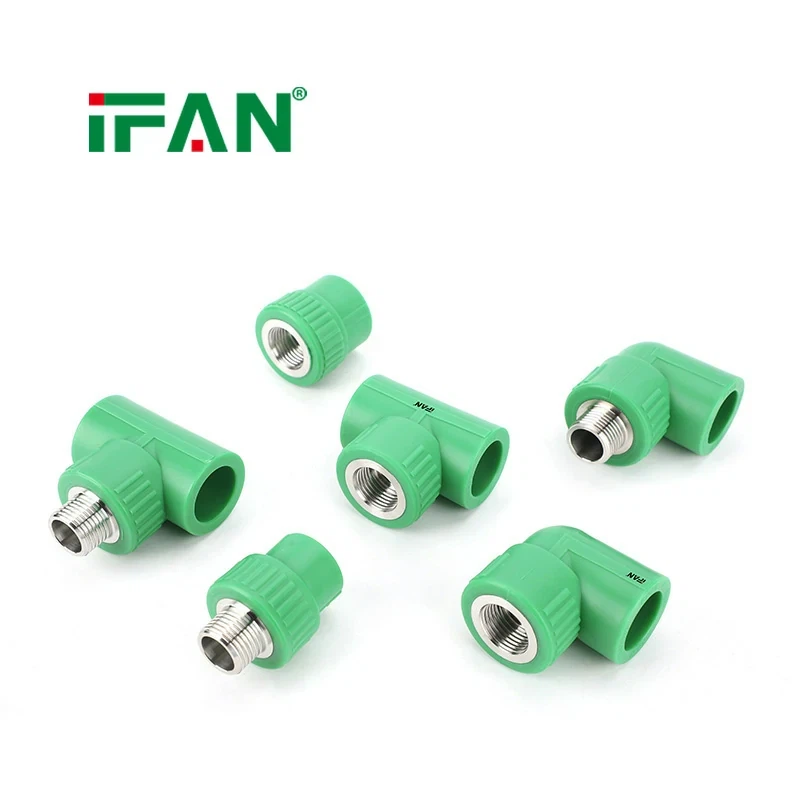
Comparison of 304 vs. 316 for PPR Fittings
Both 304 and 316 are austenitic stainless steels, meaning they are non-magnetic in their annealed state and offer excellent toughness . The key difference lies in their corrosion resistance and cost.
| Feature | Grade 304 | Grade 316 |
|---|---|---|
| Chromium | 18-20% | 16-18% |
| Nickel | 8-10.5% | 10-14% |
| Molybdenum | None | 2-3% |
| PREN Value | ~18-20 | ~24-28 |
| Corrosion Resistance | Good (general use) | Excellent (marine/chemical) |
| Chloride Sensitivity | Vulnerable | Resistant |
| Relative Cost | Baseline | +20-40% |
PREN (Pitting Resistance Equivalent Number) is calculated as %Cr + 3.3 x %Mo + 16 x %N. The 3.3x multiplier on molybdenum explains why 316 significantly outperforms 304 in chloride environments .
The Critical Role of the Low-Carbon ("L") Variants
When selecting stainless steel PPR fittings, you may encounter 304L and 316L grades. The "L" stands for "low carbon" (maximum 0.03% carbon, compared to 0.08% in standard grades) .
Why the "L" Grade Matters for Welding:
During the high-temperature injection molding process used to fuse the stainless steel insert into the PPR body, there is a risk of carbide precipitation. This occurs when chromium and carbon combine at grain boundaries, depleting the chromium that provides corrosion resistance .
The low-carbon variants (304L, 316L) minimize this risk. While PPR molding temperatures (around 260°C) are lower than welding temperatures for steel, using "L" grades is considered best practice for ensuring the long-term corrosion resistance of the insert.
Grade Selection for PPR Fittings: Application Guidelines
The choice between 304 and 316 for stainless steel PPR fittings depends entirely on the application environment .
| Application Environment | Recommended Grade | Rationale |
|---|---|---|
| Indoor potable water, standard plumbing | 304 | Cost-effective; sufficient for freshwater |
| Hot water systems (low chlorides) | 304 | Standard PPR temperature limits apply; 304 adequate |
| Industrial process water (neutral) | 304 | General corrosion resistance sufficient |
| Swimming pool water systems | 316 | Chlorinated water requires enhanced resistance |
| Coastal / salt-air environments | 316 | Chloride in air causes 304 pitting |
| Chemical plants (aggressive media) | 316 | Superior chemical resistance required |
| Pharmaceutical / medical applications | 316 | Biocompatibility and sterilization needs |
| Wastewater / reclaimed water (high chlorides) | 316 | Protection against chlorides and contaminants |
Comparison with Brass Pipe Fittings
Understanding stainless steel grades also provides context when comparing stainless steel PPR fittings to traditional brass pipe fittings.
While brass pipe fittings have been the industry standard for decades, they are vulnerable to dezincification -a process where zinc leaches out of the brass alloy in aggressive or hot water conditions. Stainless steel contains no zinc, making it immune to this specific failure mode.
For applications requiring the highest corrosion resistance, 316 stainless steel PPR fittings are often chosen over brass pipe fittings, especially in coastal areas, chemical plants, or systems using aggressive water.
The Science of Stainless Corrosion Resistance
Both 304 and 316 stainless steels resist corrosion through the formation of a passive chromium oxide layer on their surface . This layer is invisible, self-healing, and prevents oxygen from reaching the underlying metal.
When the surface is scratched, the chromium in the steel reacts with oxygen to instantly reform the protective layer. This self-healing property is what makes stainless steel "stainless" .
The molybdenum in 316 enhances this passive layer, making it more stable and resistant to attack from chlorides . This is why 316 is the standard for marine environments where salt exposure is constant.
Material Certifications and Quality
When purchasing stainless steel PPR fittings, quality manufacturers provide material certifications confirming the grade (304 or 316). This is especially important for the "L" low-carbon variants.
Key points to verify:
NSF/ANSI 61 certification for drinking water systems
ASTM A182 for stainless steel forgings (F304, F316)
Positive Material Identification (PMI) testing for critical applications
Summary Table: 304 vs. 316 Stainless Steel PPR Fittings
| Selection Factor | Grade 304 | Grade 316 |
|---|---|---|
| Best for | Standard freshwater, indoor plumbing, general industrial | Saltwater, coastal, chemical, pharmaceutical |
| Chloride limit | Low (e.g., fresh water) | High (seawater, de-icing salts) |
| Corrosion resistance | Good | Excellent |
| Relative cost | Lower (baseline) | Higher (+20-40%) |
| Typical applications | Residential water, heating systems | Marine, coastal buildings, chemical plants |
Stainless steel PPR fittings are predominantly manufactured using either 304 or 316 austenitic stainless steel grades. Grade 304 is the standard, cost-effective choice for most freshwater applications, offering good corrosion resistance and formability. For environments involving chlorides-such as seawater, de-icing salts, or aggressive industrial chemicals-Grade 316 is the superior choice due to its molybdenum content, despite its higher cost.
The selection of the correct grade is critical for ensuring the long-term reliability and leak-free performance of your PPR piping system.