
Defining the Heat Handling Capacity of PPR
Standard PPR (Polypropylene Random Copolymer) has well-defined thermal limits. The material can handle continuous operation at 70°C (158°F) for a lifespan of 50 years . Short-term peaks up to 95°C (203°F) are acceptable for brief periods, typically up to 100 hours . Above these temperatures, the polymer softens and loses pressure capacity.
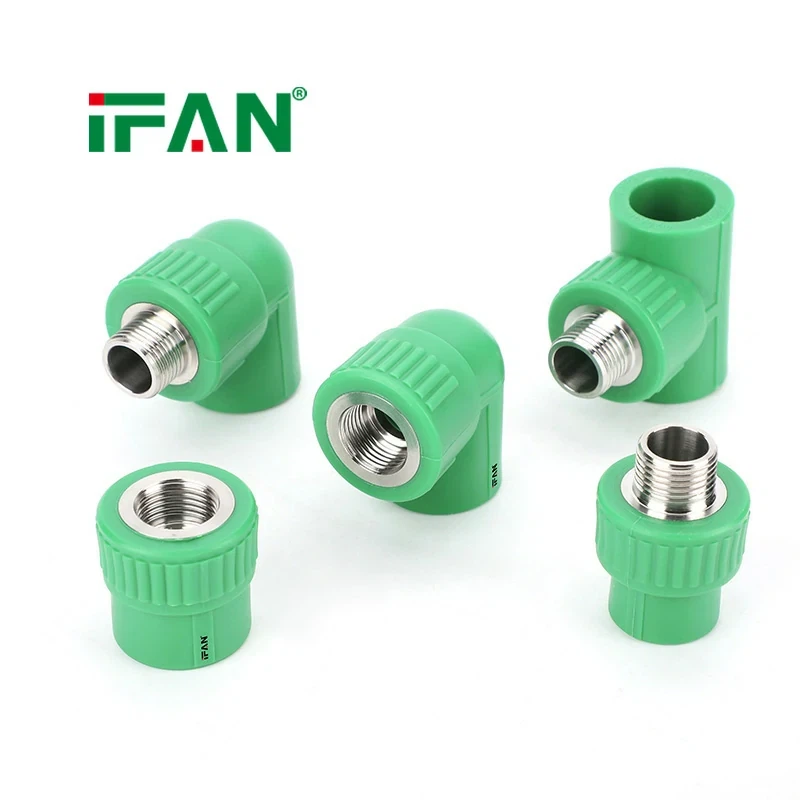
Stainless steel PPR fittings share the same PPR body material. However, the stainless steel threaded insert does not soften with heat. This creates a hybrid component with unique thermal behavior. The plastic portion remains the limiting factor, but the metal reinforcement changes how the fitting performs at high temperatures.
Comparing Maximum Temperature Ratings
The chart below shows temperature limits for PPR, stainless steel, and brass components:
| Component Type | Max Continuous Temp | Short-Term Peak Temp |
|---|---|---|
| Standard PPR Body | 70°C (158°F) | 95°C (203°F) |
| Stainless Steel (304/316) | 150°C+ (302°F+) | 200°C+ (392°F+) |
| Brass | 120-150°C (248-302°F) | Varies by alloy |
Data compiled from .
The PPR body is the limiting component in stainless steel PPR fittings. However, the metal thread maintains its integrity at temperatures that would degrade standard PPR threads. This is the key difference between hybrid fittings and all-plastic fittings.
The Critical Issue: Temperature De-Rating
All PPR-based products lose pressure capacity as temperature rises. This is called "de-rating." A PN25-rated fitting at 20°C has significantly lower pressure capacity at 70°C .
The table below shows how pressure capacity changes with temperature:
| Operating Temperature | Pressure Capacity (PN25 Example) |
|---|---|
| 20°C (68°F) | 25 bar (362 PSI) |
| 40°C (104°F) | ~20 bar (290 PSI) |
| 60°C (140°F) | ~15 bar (218 PSI) |
| 70°C (158°F) | ~12.5 bar (181 PSI) |
Data compiled from .
Stainless steel PPR fittings follow the same de-rating curve as standard PPR. However, their reinforced thread allows them to maintain seal integrity even when the plastic body is near its thermal limit. This is not possible with all-plastic threaded fittings.
The Advantage of Stainless Steel Threads
Standard PPR fittings are often all-plastic. This includes threaded connections, which have limited strength at high temperatures. Plastic threads can strip or deform when hot.
Stainless steel PPR fittings use metal threads. The stainless steel insert handles the mechanical stress of the threaded connection. The PPR body provides the pipe connection. This separation of functions is crucial .
For a connection to a hot water heater or boiler, the stainless steel threads maintain their grip. The PPR body expands with heat, but the metal thread does not soften. This prevents leaks that commonly occur with all-plastic threaded fittings in hot service .
Models with Extended Temperature Ranges
Manufacturers offer stainless steel PPR fittings in different performance grades . The selection below shows how the stainless steel component enables higher ratings:
| Model | Temp Range | Key Feature |
|---|---|---|
| Base Model | -10°C to 70°C | Standard PPR + Stainless Steel |
| Advanced Model | -20°C to 95°C | Enhanced PPR + Steel Reinforcement |
| Pro Model | -30°C to 110°C | Premium PPR + 316 Stainless Steel |
Data compiled from .
The Pro Model's 316 stainless steel threads allow the fitting to operate at the very limit of PPR material science. The temperature rating is still bound by the plastic body, but the metal component provides maximum durability at those extremes.
Thermal Expansion: A Key Difference
Different materials expand at different rates with heat. This matters for system longevity.
| Material | Coefficient (x10⁻⁶/°C) |
|---|---|
| PPR | 110-120 |
| Stainless Steel (304) | 17.3 |
| Brass | 19.0 |
| Copper | 16.6 |
Data from .
PPR expands roughly 6 times more than stainless steel. Stainless steel PPR fittings contain two materials with very different expansion rates. During heating and cooling cycles, this differential creates internal stress .
In a standard PPR fitting, the entire component expands uniformly. In a stainless steel PPR fitting, the metal insert resists expansion while the plastic body expands around it. This is managed by the injection molding process, which bonds the materials at the molecular level. The design must accommodate this stress .
For long pipe runs, expansion loops or offsets are still required. The fitting itself can handle the differential expansion, but the pipe system needs room to move.
Comparison with Brass PPR Fittings
Brass pipe fittings are also used as threaded inserts in PPR systems. They offer similar heat performance to stainless steel, but with important differences.
| Feature | Stainless Steel PPR | Brass PPR |
|---|---|---|
| Max Temp | 95-110°C (203-230°F) | 120-150°C (248-302°F) |
| Corrosion at High Temp | Excellent (no dezincification) | Vulnerable to dezincification |
| Thermal Expansion | 17.3 x10⁻⁶/°C | 19.0 x10⁻⁶/°C |
Data compiled from .
While brass can technically handle higher temperatures, it is vulnerable to dezincification in aggressive water conditions, especially at elevated temperatures . Stainless steel contains no zinc and is immune to this failure mode. For hot water applications with aggressive chemistry, stainless steel is superior.
Typical Applications for High-Temperature Service
Stainless steel PPR fittings are used in several high-temperature applications :
Residential Hot Water: Supply lines from water heaters (60-70°C)
Solar Thermal Systems: Can withstand stagnation temperatures up to 120°C
Underfloor Heating: Manages water or glycol in radiant loops
Commercial Heating: Hotel and hospital hot water systems
Industrial Processes: Chemical transport at moderate temperatures
For each application, the correct model grade (Base, Advanced, or Pro) should be selected based on the actual operating temperature.
Pressure De-Rating at High Temperatures
As temperature rises, the allowable pressure drops. This is true for all PPR-based systems. For stainless steel PPR fittings, the PN25 rating (25 bar at 20°C) is reduced significantly at 70°C.
A PN25 fitting at 70°C continuous operation is safe for approximately 12.5 bar (181 PSI) . This is still adequate for most residential and commercial systems, which typically operate at 3-8 bar (45-115 PSI). For high-rise buildings, the higher rating provides necessary margin.
Stainless steel PPR fittings handle high temperatures better than standard all-plastic fittings because the metal thread does not lose strength with heat. However, the PPR body remains the limiting factor. The hybrid design maximizes what is possible within the material's inherent limits.