


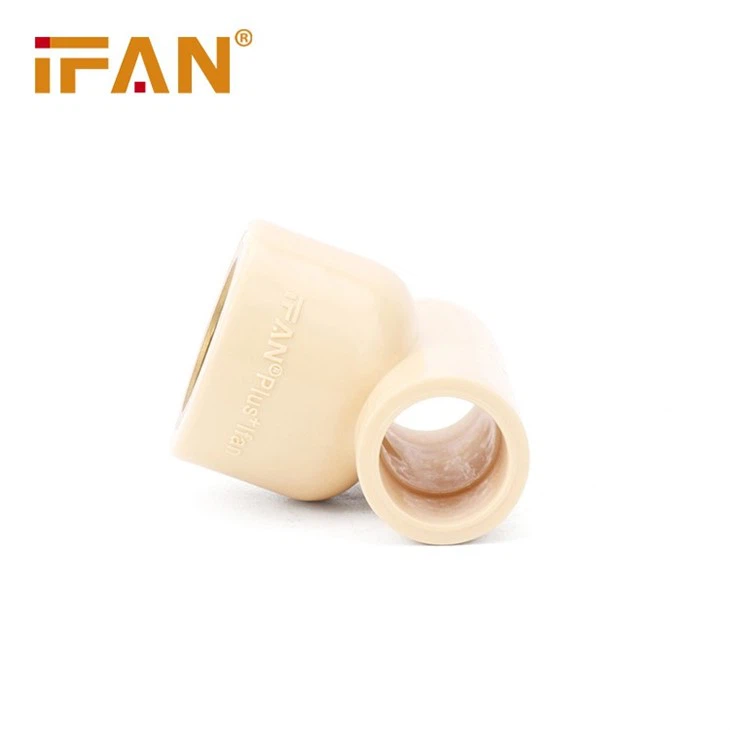

Wholesale Cream Color CPVC Pipe Fitting
Brand: IFAN
Connecting method:PVC Glue
Applications:Potable Water Systems
Color:Cream Color
Send Inquiry
Product Details ofWholesale Cream Color CPVC Pipe Fitting
Introduction
CPVC stands for chlorinated polyvinyl chloride. This material offers excellent resistance to heat and corrosion. Many industries favor CPVC due to its durability and versatility.

| Product Name | CPVC Pipe Fitting |
| Color | Cream Color |
| Size | 1/2"-2" |
| Brand | IFAN or Customized |
| OEM |
Support |
| Sample | Free |
| Experience | 30+Years |
| Contact Us | Click HERE to contact us now! |
Welcome to contact IFAN, we are online 24 hours a day to answer your questions!
Tensile Strength Characteristics of CPVC Pipe Fittings
1. Introduction to Tensile Strength in CPVC Materials
Tensile strength is a critical mechanical property of materials, defining their ability to withstand tension without failure. For CPVC (Chlorinated Polyvinyl Chloride) pipe fittings, understanding tensile strength is essential, as it determines the material's performance in various applications, particularly in plumbing and chemical transport. CPVC, due to its unique molecular structure and the chlorination process, exhibits enhanced properties compared to standard PVC. The tensile strength of CPVC typically ranges from 5,000 to 7,500 psi, depending on specific formulations and processing methods. This high tensile strength makes CPVC an ideal choice for high-pressure applications, ensuring that the fittings can endure significant forces without deforming or breaking.
2. Importance of Measuring Tensile Strength
Measuring tensile strength is crucial for ensuring that CPVC fittings can perform adequately under operational stresses. In practical applications, these fittings often experience various forces, including pressure from fluids, temperature changes, and external mechanical impacts. If the tensile strength is insufficient, the fittings may fail, leading to leaks or catastrophic system failures. Testing for tensile strength helps manufacturers assess the quality and reliability of their products, allowing them to meet industry standards and regulations. Additionally, knowing the tensile strength helps engineers design systems that accommodate the physical demands placed on the fittings, ensuring safety and efficiency.
3. Testing Methods for Tensile Strength
Tensile strength is typically assessed using standardized testing methods such as ASTM D638, which outlines procedures for determining the tensile properties of plastics. In this test, a specimen of CPVC is shaped into a standardized form and subjected to a tensile load until it fractures. The maximum load applied is recorded, and calculations are performed to determine the tensile strength. This testing method ensures consistency and comparability across different batches of CPVC products. By adhering to these standardized testing protocols, manufacturers can produce reliable data that can be used for quality control and product development.
4. Factors Affecting Tensile Strength
Several factors influence the tensile strength of CPVC pipe fittings, including the material formulation, processing conditions, and environmental factors. The specific type and amount of additives used in the CPVC formulation can significantly affect its mechanical properties. For instance, impact modifiers and stabilizers can enhance toughness and resistance to environmental stress cracking. Additionally, the processing conditions, such as temperature and cooling rates during manufacturing, can influence the molecular orientation of the material, thereby affecting its strength. Understanding these factors is essential for manufacturers aiming to optimize their products and ensure consistent performance in various applications.


Hot Tags: wholesale cream color cpvc pipe fitting, China wholesale cream color cpvc pipe fitting manufacturers, suppliers, factory, PPR Plastic Union, PPR Seated Female Elbow, PPR Elbow Reducer, PPR Single Union Ball Valve, PPR Reducing Socket, PPR Plastic Pipe
Send Inquiry
