


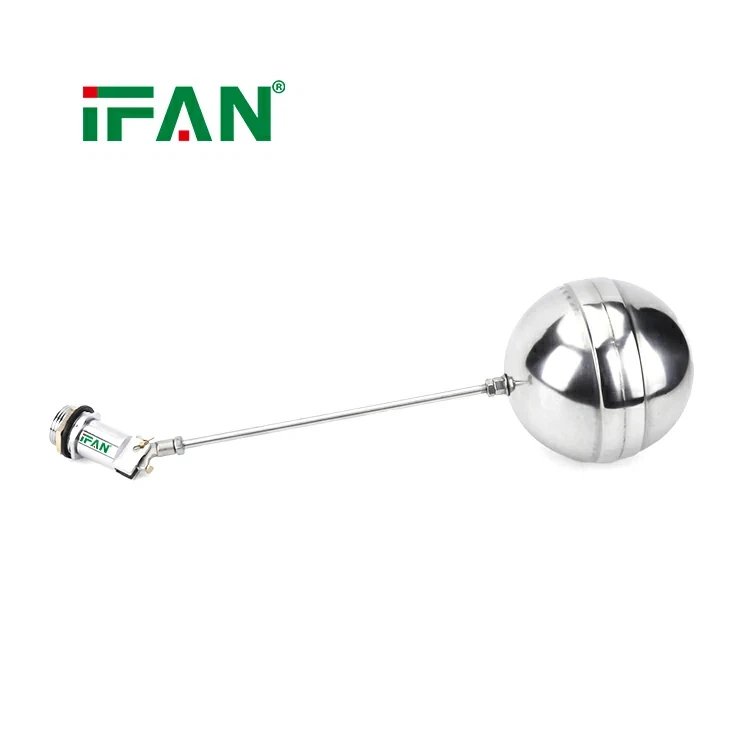

Stainless Steel Float Valve Level Control
Brand:IFAN
Connecting method:Thread
Applications:Water Systems
Color:Silver
Send Inquiry
Product Details ofStainless Steel Float Valve Level Control

| Product Name | Stainless steel float valve |
| Color | Stainless steel Color |
| Size | 1/2''-1'' |
| Brand | IFAN or Customized |
| OEM |
Support |
| Sample | Free |
| Experience | 30+Years |
| Contact Us | Click HERE to contact us now! |
Welcome to contact IFAN, we are online 24 hours a day to answer your questions!
Concept of Level Control in Fluid Systems
Level control is the process of maintaining liquid height within a defined range. It is essential for stable and safe fluid system operation. Float valves achieve this function through mechanical response to liquid movement. As the liquid level changes, the valve reacts automatically. This method provides continuous regulation without external energy. Stainless steel float valve level control is valued for simplicity and reliability. Accurate level control prevents overflow and insufficient supply conditions. Many systems depend on consistent liquid availability. Level stability supports process continuity and equipment protection. This control concept is widely applied in industrial and commercial environments.
Fundamental Working Principle of Level Control
Level control operates through buoyancy forces acting on a float. When liquid rises, the float moves upward accordingly. This movement gradually closes the inlet passage. When liquid drops, the float descends and opens the inlet. The process repeats continuously during operation. Mechanical linkage converts float motion into valve action. The response is proportional to level variation. No sensors or electronics are required. This simplicity improves reliability in harsh environments. Level control remains accurate through direct physical interaction with the fluid.
Stability and Consistency in Operation
Stable level control maintains liquid height within narrow limits. Consistency reduces stress on connected equipment. Pumps benefit from steady suction conditions. Tanks avoid pressure variations caused by level swings. Mechanical control reacts smoothly to demand changes. Stability improves overall system efficiency. Repeated cycling is minimized through proper balance. Consistent control supports predictable process outcomes. Long-term stability reduces maintenance requirements. Level control directly contributes to operational reliability.
Adaptation to Changing Operating Conditions
Level control must adapt to varying flow rates. Supply pressure changes influence inlet behavior. Mechanical control adjusts automatically to these variations. The float responds to actual liquid height, not flow rate. This adaptability improves robustness. Temperature changes may affect fluid density slightly. Well-designed systems accommodate these effects. Level control remains functional across different operating states. Stainless steel float valve level control handles dynamic conditions effectively. Adaptability is a key advantage in practical applications.
Integration Within Larger Control Systems
Level control often works alongside other control elements. It supports pumps, pipelines, and storage tanks. The float valve acts as a primary regulating component. Integration does not require complex interfaces. Mechanical control complements electronic monitoring systems. It provides a basic safety layer. Level control continues even if other systems fail. This independence improves system resilience. Integration simplicity reduces installation complexity. Reliable level regulation strengthens overall system design.


Hot Tags: stainless steel float valve level control, China stainless steel float valve level control manufacturers, suppliers, factory
Send Inquiry
