
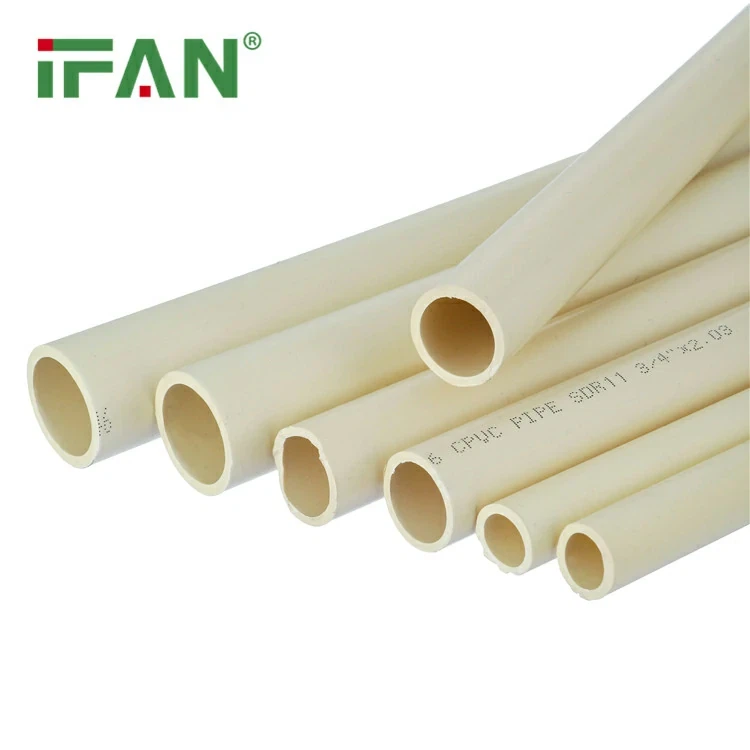


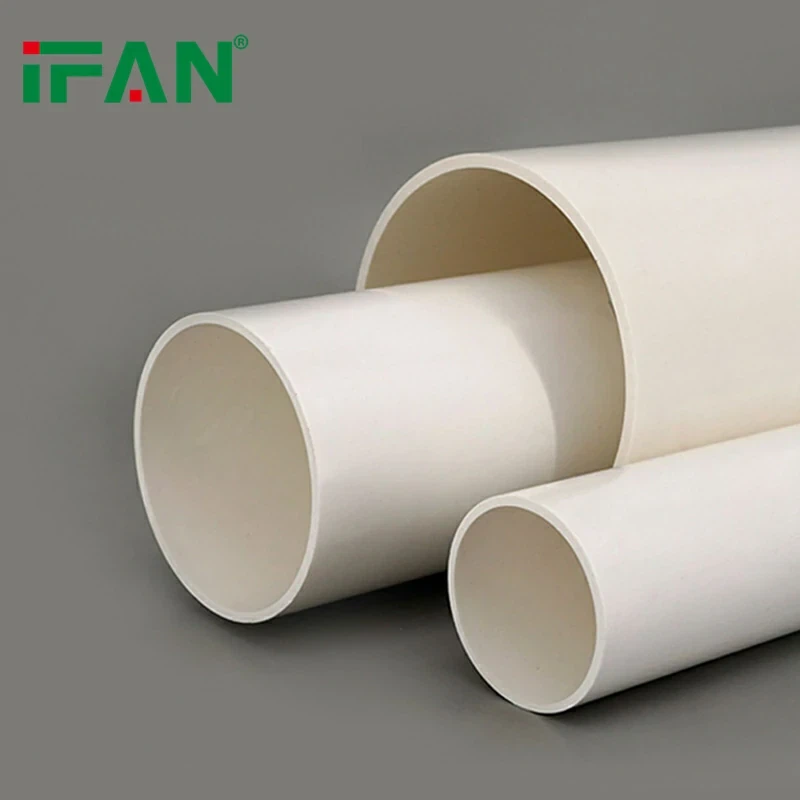
Stress Resistance CPVC Pipe
Brand: IFAN
Connecting method:PVC Glue
Applications:Residential Plumbing,Industrial Piping Systems
Color:Beige/White or Customized
Send Inquiry
Product Details ofStress Resistance CPVC Pipe
Introduction
CPVC (Chlorinated Polyvinyl Chloride) fittings are a popular choice for plumbing systems due to their durability and resistance to various environmental factors. One of their key advantages is their high-temperature resistance. In this article, we'll explore why CPVC fittings are an ideal option for systems that handle hot water and how their heat-resistant properties benefit plumbing systems in residential, commercial, and industrial settings.

| Product Name | CPVC Pipe Fitting |
| Standard | ASTM 2846 |
| Color | Beige Color |
| Size | 1/2"-2" |
| Brand | IFAN or Customized |
| OEM |
Support |
| Sample | Free |
| Experience | 30+Years |
| Contact Us | Click HERE to contact us now! |
Welcome to contact IFAN, we are online 24 hours a day to answer your questions!
Material Structure and Internal Stress Behavior
CPVC pipe is made from a chlorinated version of polyvinyl chloride resin. This material has a high molecular weight and rigid structure. The chlorine atoms in the polymer chain increase resistance to external and internal stresses. The polymer matrix is tightly packed, reducing voids or weak points in the material. When under pressure, the material structure distributes the force across the pipe wall. This reduces localized stress that can lead to cracks over time. The pipe surface does not exhibit visible deformation during high-pressure conditions. CPVC's density and uniformity are maintained during extrusion and cooling processes. The pipe remains round and structurally consistent across its length. Stress concentrations are minimized through smooth internal and external surfaces. Micro-defects are rare due to high-quality production methods. The material does not expand or flex under pressure in the same way as softer plastics. Its behavior remains predictable and measurable when exposed to sustained pressure. CPVC exhibits long-term resistance to material fatigue caused by repeated loading. This durability is directly related to the compound's molecular structure and internal cohesion.
Manufacturing Standards and Quality Control
CPVC pipe is produced using strict manufacturing protocols to ensure consistency. The resin is compounded with additives to enhance processing and stability. During extrusion, temperature and pressure are controlled for precise material flow. The pipe is cooled in a calibrated environment to avoid stress development. Wall thickness is measured continuously to prevent weak points from forming. Each pipe undergoes dimensional verification before leaving the factory. Surface quality is visually and mechanically inspected for scratches or inconsistencies. Internal diameter measurements confirm uniform flow paths and balanced wall strength. The pipe's roundness is monitored to maintain even distribution of internal forces. Burst testing is used to evaluate pressure endurance under short-term load. Long-term hydrostatic tests simulate years of internal pressure exposure. CPVC must meet or exceed national and international standards for performance. Every batch is traceable with markings for date and production run. This traceability ensures accountability in case of performance concerns. All testing is documented and reviewed for quality assurance. These quality measures help prevent failure from internal stress and microfractures. The pipe's resilience starts at the molecular and manufacturing level.
Response to Sustained Internal Pressure
CPVC pipe is capable of handling constant internal pressure over extended periods. The material does not soften or deform when exposed to static internal loads. Wall thickness is designed to withstand typical internal force ranges. Testing shows that the pipe does not exhibit creep under normal operating conditions. Creep resistance helps avoid wall thinning and shape distortion over time. The internal surface remains smooth and free of wear even under pressurized flow. CPVC maintains pressure ratings without developing internal surface cracks. Thermal expansion does not combine with pressure to create structural failure. The pipe remains round, with no signs of bulging at high-stress points. Stress analysis reveals even distribution of force along the inner circumference. There is no sharp stress concentration that can trigger fractures. Pressure-induced strain remains within the elastic range of the material. The pipe rebounds to its original shape after pressure is released. These properties remain consistent across multiple cycles of pressurization. Fatigue cracking from internal force repetition does not occur under proper conditions. Laboratory simulations demonstrate excellent retention of pressure strength over time.
Resistance to Crack Initiation and Propagation
Crack resistance is one of CPVC's important mechanical strengths. The material resists crack formation even when exposed to pressure over time. Microscopic inspection reveals no initiation of cracks under constant load. Stress is dispersed uniformly to prevent sudden structural failure. If any flaw appears, it does not quickly propagate through the wall. Crack growth in CPVC is slow and predictable under pressure. The material's toughness limits the length and depth of surface fractures. The pipe does not support brittle fracture under internal tension. Even in the presence of surface imperfections, cracks remain stable. Standardized impact and tensile tests confirm this behavior across pipe diameters. CPVC does not splinter or tear in response to stress. Its energy absorption capacity reduces the likelihood of sudden rupture. Cracks that do appear do not travel rapidly or in straight lines. The polymer structure redirects crack growth to slow down spread. The pipe can maintain service conditions despite small imperfections. This toughness is critical for high-pressure performance. Predictable crack behavior supports planning and maintenance strategies.
Long-Term Mechanical Stability
Over time, CPVC pipe retains its mechanical strength under pressure. The material does not become brittle or weak after years of use. Stress relaxation remains within acceptable limits under controlled temperatures. There is no observed loss of wall strength under sustained loads. Fatigue testing shows minimal change in performance after repeated cycling. Dimensional checks reveal stable outer diameter and wall thickness over time. Internal pressure does not cause microvoid development in the material body. The pipe keeps its form and flexibility over years of service. Aging tests simulate multi-year pressure exposure without significant loss. The pipe resists internal delamination or surface roughening from flow. Structural properties are not affected by surrounding environmental conditions. The pipe wall maintains homogeneity under internal stress exposure. Visual inspection after aging shows no internal crack patterns. The mechanical integrity of CPVC remains intact throughout its service life. This long-term strength is due to material composition and consistent structure. External vibration or minor movements do not contribute to crack growth. CPVC resists pressure-induced failure under both static and dynamic conditions.
Environmental Conditions and Pressure Behavior
Environmental variables have limited impact on CPVC's pressure performance. The pipe retains strength in areas with fluctuating temperatures. Expansion and contraction do not produce wall stress cracks. CPVC absorbs minor shock from temperature and pressure variation. Humidity and moisture have no effect on internal crack behavior. The pipe is non-porous and does not support water absorption. CPVC resists pressure-induced failure even when installed in enclosed spaces. Insulation or covering does not affect its pressure resistance. The pipe does not experience chemical stress cracking under normal indoor exposure. Atmospheric gases or dust do not weaken the pipe's surface. CPVC is stable under indirect UV exposure in protected environments. There is no interaction between light exposure and internal stress behavior. Pressure monitoring remains stable in variable ambient conditions. The pipe exhibits no pressure drop due to material deformation. Its strength is not compromised by seasonal environmental changes. These factors ensure consistent pressure performance across locations. CPVC performs predictably under realistic indoor environmental stressors. No significant impact from air flow, temperature gradient, or humidity is observed.


Hot Tags: stress resistance cpvc pipe, China stress resistance cpvc pipe manufacturers, suppliers, factory, CPVC Plastic Pipe
Previous
No InformationSend Inquiry
