
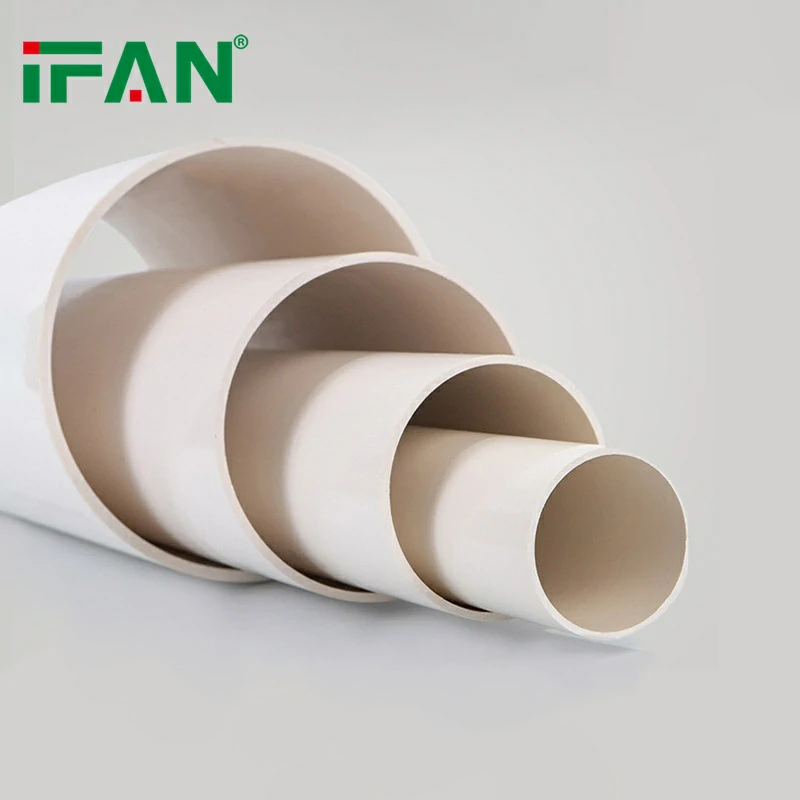


CPVC Pipe Resists Corrosion And Chemicals
Brand: IFAN
Connecting method:PVC Glue
Applications:Residential Plumbing,Industrial Piping Systems
Color:Beige/White or Customized
Send Inquiry
Product Details ofCPVC Pipe Resists Corrosion And Chemicals
Introduction
CPVC (Chlorinated Polyvinyl Chloride) fittings are a popular choice for plumbing systems due to their durability and resistance to various environmental factors. One of their key advantages is their high-temperature resistance. In this article, we'll explore why CPVC fittings are an ideal option for systems that handle hot water and how their heat-resistant properties benefit plumbing systems in residential, commercial, and industrial settings.

| Product Name | CPVC Pipe Fitting |
| Standard | ASTM 2846 |
| Color | Beige Color |
| Size | 1/2"-2" |
| Brand | IFAN or Customized |
| OEM |
Support |
| Sample | Free |
| Experience | 30+Years |
| Contact Us | Click HERE to contact us now! |
Welcome to contact IFAN, we are online 24 hours a day to answer your questions!
Chemical Composition and Material Properties
CPVC stands for chlorinated polyvinyl chloride and is produced by chlorinating standard PVC resin to enhance its performance under more demanding conditions. The chlorination process modifies the polymer chain, increasing the material's resistance to temperature and chemical exposure. Chlorine atoms are integrated into the structure, making the polymer more rigid and stable. This molecular change improves the pipe's ability to withstand environmental and chemical stress. During manufacturing, specific additives are incorporated to ensure consistent physical performance and structural integrity. These may include heat stabilizers, processing aids, and pigments. The result is a smooth, dense material with uniform wall thickness and excellent form retention. CPVC remains dimensionally stable under thermal and mechanical conditions, making it a preferred choice for installations where material purity and stability are critical. The surface is non-porous and does not absorb moisture from its surroundings. The pipe retains its shape during handling, storage, and cutting processes. Tests conducted on CPVC samples show reliable tensile strength and compression resistance. These material characteristics are tightly controlled through standardized production protocols and quality assurance processes that verify compliance with industry specifications. Manufacturing precision is key to ensuring performance consistency across various production batches.
Corrosion Resistance Characteristics
CPVC naturally resists corrosion due to its non-metallic composition and stable molecular structure. Unlike metal materials, it does not rust or oxidize when exposed to moisture, air, or other environmental elements. The polymer does not require any coating or secondary treatment to prevent degradation from corrosive environments. CPVC pipes retain their structure and appearance even after prolonged exposure to damp or chemically aggressive conditions. The outer surface does not flake, blister, or peel when placed in contact with corrosive vapors or splashes. Internally, the pipe maintains smooth surfaces that do not promote buildup or corrosion-related erosion. Because CPVC is inert to most atmospheric and environmental agents, it offers a stable solution for exposure to water, steam, and varying pH levels. Electrochemical reactions common with metallic piping do not occur in CPVC materials. As a result, there is no risk of galvanic corrosion when installed near other conductive systems. Its uniformity and non-reactive nature eliminate the weak spots often caused by corrosion in metal-based systems. CPVC does not suffer from microcracks or stress fractures associated with corrosion fatigue. Long-term studies demonstrate the material's ability to resist both external and internal forms of chemical deterioration under consistent operational conditions.
Chemical Resistance Performance
CPVC is engineered to resist a wide range of chemical substances commonly encountered in industrial and controlled environments. Its structure remains unaffected by exposure to acids, alkalis, salts, and many organic compounds. The presence of chlorine within the polymer chain strengthens the material's resistance to chemical attack. It forms a barrier that prevents aggressive substances from penetrating or reacting with the base material. The pipe's inner surface remains unchanged when exposed to low and high concentrations of chemicals over time. The absence of softening or swelling in response to contact with solvents is a key property of CPVC. Detailed chemical compatibility charts are maintained by manufacturers to guide proper use of CPVC in specific environments. These references identify which substances CPVC can withstand and at what concentrations and temperatures. The pipe does not support the absorption of harmful materials or allow migration through its walls. Its resistance extends to oxidizing agents and non-polar solvents as well. Tests under laboratory and real-world conditions confirm the pipe's ability to remain structurally sound despite long-term chemical exposure. The predictable behavior of CPVC under various chemical conditions makes it suitable for situations requiring precise material performance and chemical stability.
Thermal and Structural Stability
CPVC exhibits excellent thermal stability and mechanical consistency over a wide temperature range. It maintains rigidity under moderate to high operating temperatures without deforming or losing shape. The material's glass transition temperature is higher than that of standard PVC, allowing it to remain functional in elevated thermal environments. Thermal expansion in CPVC is predictable, allowing for accurate planning during system design and installation. Its resistance to heat-induced stress makes it less susceptible to warping or softening compared to other thermoplastics. In addition to thermal resistance, CPVC shows steady structural behavior under physical loads. The pipe can handle reasonable impact forces during transportation and installation without cracking or breaking. Compression and flexural tests show that CPVC retains its form under pressure without significant deflection. The material does not exhibit significant creep or fatigue under continuous mechanical stress. Even under repeated heating and cooling cycles, CPVC retains its original mechanical properties. Long-term aging tests show no significant loss in tensile strength or elongation. The pipe does not become brittle or develop surface fractures over time. This mechanical durability, combined with thermal consistency, makes CPVC a stable material for a variety of conditions requiring dimensional and structural integrity.
Manufacturing Process and Quality Assurance
CPVC pipes are produced using extrusion techniques under closely monitored processing conditions. The base resin is blended with performance-enhancing additives before being melted and extruded through precision dies. Temperature, pressure, and cooling are tightly controlled to ensure consistent wall thickness and shape. Post-extrusion, the pipe is cut to length and subjected to various quality tests. These tests verify mechanical strength, dimensional accuracy, and surface smoothness. Samples are routinely tested for tensile strength, burst pressure, and chemical composition. Non-destructive testing methods are often used to check for voids, inclusions, or surface defects. Manufacturers follow national and international standards to ensure that every product batch meets regulatory and safety guidelines. Lot tracking systems are implemented to trace material origins and production settings. Pipe markings include size, material grade, and compliance information for easy identification. Finished pipes are stored in climate-controlled facilities to protect them from UV exposure and physical damage. Inventory is rotated regularly to maintain product freshness and prevent long-term storage issues. Consistent product quality is maintained through a combination of automation, employee training, and statistical process controls. The result is a reliable and repeatable production outcome that supports consistent field performance.
Durability and Physical Retention
CPVC is designed for long-term use in challenging environments where mechanical and chemical stability are essential. It retains its form and performance properties even after extended exposure to thermal and chemical stresses. The material's surface does not fade, chalk, or degrade under normal storage or use conditions. Resistance to UV light can be enhanced by adding specific stabilizers during manufacturing. When properly protected, CPVC can be stored or installed in locations exposed to indirect sunlight. The pipe does not absorb moisture, which helps maintain consistent weight and internal pressure ratings. Its low water absorption also prevents dimensional changes due to humidity. Long-term performance evaluations show that CPVC retains strength, impact resistance, and elasticity under continuous service. The pipe does not become brittle with age and resists stress cracking. It does not support microbial growth or allow organic buildup on its surfaces. Structural evaluations confirm that aging does not significantly reduce the pipe's wall thickness or internal diameter. The long-term mechanical behavior remains consistent with original material specifications. This predictability makes CPVC a stable and durable option for conditions that require long-lasting material properties without degradation or change over time.


Hot Tags: cpvc pipe resists corrosion and chemicals, China cpvc pipe resists corrosion and chemicals manufacturers, suppliers, factory, CPVC Plastic Pipe
Previous
Easy Installation CPVC PipeNext
IFAN CPVC PipesSend Inquiry
