


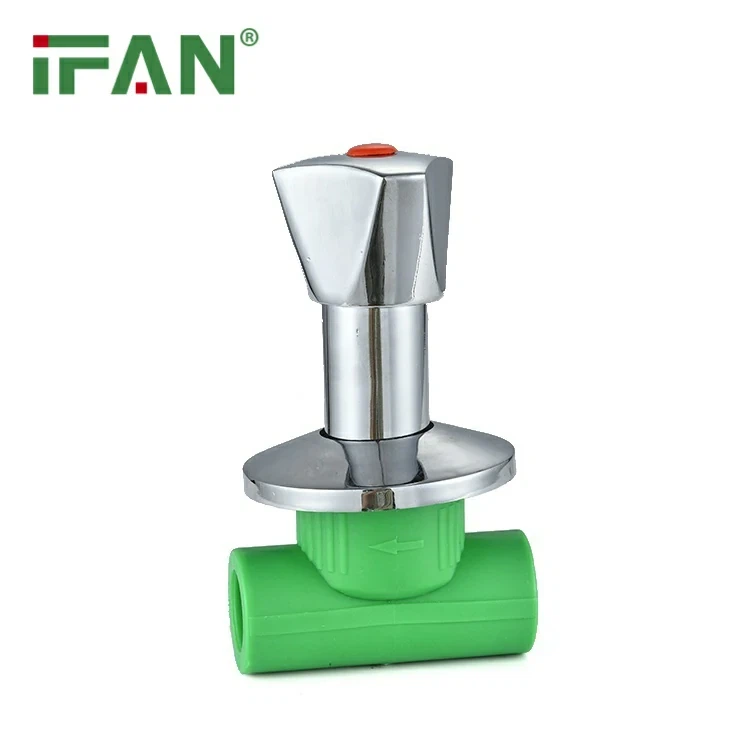


PPR Concealed Valve For High Temptures
Color:Green Or Customized
Brand:IFAN/IFANPLUS/OEM/No Brand
Connecting method:Welding Or Customized
Applications:Water Control
Experience;30+years
OEM&ODM:Support
Sample:Free
Send Inquiry
Product Details ofPPR Concealed Valve For High Temptures
IFAN factory 30+ years manufacture experience support color /size customization support free sample.Welcome to consult for catalog and free samples.This is our Store Website:https://www.ifan-plast.com/,Click to watch IFAN's product video.Our IFAN products are your best choice from quality to price, welcome to buy!

PPR concealed valves are specifically designed to withstand high temperatures in plumbing systems. One of the key characteristics of PPR (Polypropylene Random Copolymer) is its impressive thermal stability, making it an ideal material for systems that deal with elevated temperatures. When subjected to high heat, the material does not warp, degrade, or lose its structural integrity. This thermal resistance ensures that the valve can perform reliably, even in systems with high-temperature water flows.
| Product Name | PPR Concealed Valve |
| Color | Green Or Customized |
| Feature | Corrosion Protection |
| OEM | Support |
| Sample | Free |
| Experience | 30+Years |
| Contact Us | Click HERE to contact us now!we are online 24 hours a day to answer your questions! |
Welcome to contact IFAN, we are online 24 hours a day to answer your questions!
The ability of PPR to handle high temperatures is primarily due to the unique properties of the polymer. Unlike metals or other materials, PPR does not conduct heat, which allows it to maintain its strength when exposed to hot water. Materials that conduct heat are more likely to expand and contract with temperature fluctuations, which can lead to leaks or damage. PPR, however, remains stable under thermal stress, ensuring that the valve's components remain tightly sealed and secure.
PPR valves are engineered to handle water temperatures of up to 95°C (203°F) under normal operating conditions. This is significantly higher than many traditional valve materials, such as copper or steel, which can deteriorate or deform at high temperatures. PPR's ability to retain its form at elevated temperatures is a key factor that makes it suitable for various high-temperature plumbing applications. The material's thermal resistance also reduces the need for additional insulation or protective coatings, simplifying the system's design and installation.
Another important factor in the high-temperature resistance of PPR concealed valves is the absence of metal components. Metals, especially when exposed to constant high heat, can corrode, weaken, and lose their functionality over time. This process is known as thermal degradation. In contrast, PPR does not corrode or degrade when exposed to high temperatures, ensuring that the valve remains functional for a longer period. The non-metallic nature of PPR also prevents it from reacting to chemicals or minerals in the water, which can be exacerbated by heat in metal-based systems.
The molecular structure of PPR contributes to its ability to withstand high temperatures. PPR is a thermoplastic polymer, meaning it can be molded at high temperatures during the manufacturing process. This gives the material excellent thermal stability, as it is inherently capable of handling fluctuations in temperature without undergoing significant structural changes. Unlike other materials that may soften, warp, or crack when exposed to heat, PPR retains its rigidity and strength, making it ideal for use in high-temperature environments.
One of the challenges in high-temperature plumbing systems is maintaining consistent pressure and flow despite thermal fluctuations. As water heats up, it expands, which can lead to pressure changes in the system. Traditional valves may experience leaks or malfunctions due to the expansion of metal parts. PPR, however, has a lower coefficient of thermal expansion compared to metals, meaning it expands and contracts less with temperature changes. This results in a more stable, reliable valve that can handle high temperatures without the risk of failure or leakage due to thermal expansion.
Additionally, PPR's resistance to high temperatures also contributes to its safety in plumbing systems. In high-temperature environments, materials that are not thermally stable can become hazardous, potentially leading to ruptures or failures. PPR's structural stability ensures that the valve will not rupture or crack, even under extreme heat. This high-temperature resilience makes PPR concealed valves a safe choice for systems where hot water is regularly used, such as heating systems or industrial applications.
PPR's ability to maintain performance at high temperatures also reduces the risk of thermal fatigue. Thermal fatigue occurs when materials are exposed to repeated cycles of high heat, leading to cracks and eventual failure. With metals, this is a common issue, as the constant expansion and contraction can cause the material to weaken over time. PPR, however, is less susceptible to thermal fatigue due to its excellent resistance to heat-induced stress. This makes it a more durable and long-lasting option in environments where temperature fluctuations are frequent.
When exposed to high temperatures, many materials may also release harmful substances or degrade in ways that affect water quality. Metals, for example, can release metal ions or other by-products that may contaminate the water supply. PPR, on the other hand, does not leach harmful substances, even when exposed to hot water. This thermal stability ensures that the water passing through the valve remains clean and uncontaminated, maintaining the safety and integrity of the system.
In high-temperature systems, thermal expansion can sometimes result in leaks or joint failures if the materials used are not properly rated for the heat. PPR concealed valves are designed to handle these conditions, ensuring that the seals and joints remain intact even under high thermal stress. The material's ability to withstand thermal expansion without losing its sealing properties ensures that the system remains leak-free and operates efficiently over time, even in systems subjected to high temperatures.
Another important consideration in high-temperature plumbing systems is the impact of UV light and extreme environmental conditions on valve materials. Many materials, particularly metals, can degrade under prolonged exposure to UV rays, which can accelerate corrosion or cause cracking. PPR, however, is highly resistant to UV degradation. This makes it especially useful in systems that are exposed to sunlight or other environmental factors. The UV resistance of PPR ensures that the concealed valve will continue to function effectively, even when subjected to the external heat and light from the environment.
PPR valves also provide thermal insulation to the surrounding plumbing system. Since PPR does not conduct heat, it helps prevent heat loss in the system. In high-temperature systems, this means that the heat from the water is better retained, reducing the amount of energy required to maintain desired temperatures. This thermal efficiency can also help reduce overall system wear and tear, as the system is less likely to be subjected to thermal stress due to rapid temperature changes.
In conclusion, the ability of PPR concealed valves to withstand high temperatures is a critical feature that enhances their reliability and longevity in plumbing systems. PPR's thermal stability ensures that it can handle temperatures of up to 95°C without degrading, expanding, or losing strength. Its resistance to thermal expansion, thermal fatigue, and UV degradation makes it ideal for high-temperature environments. PPR valves also prevent contamination and maintain consistent water flow, even under extreme heat conditions. The durability and stability of PPR at high temperatures make it a reliable choice for modern plumbing systems exposed to elevated thermal conditions.


Hot Tags: ppr concealed valve for high temptures, China ppr concealed valve for high temptures manufacturers, suppliers, factory, PPR Water Heater Tee, PPR Air Vent Valve, PPR Plastic Union, PPR Double Union Ball Valve, PPR Elbow Reducer, PPR Male Threaded Union
Send Inquiry
