


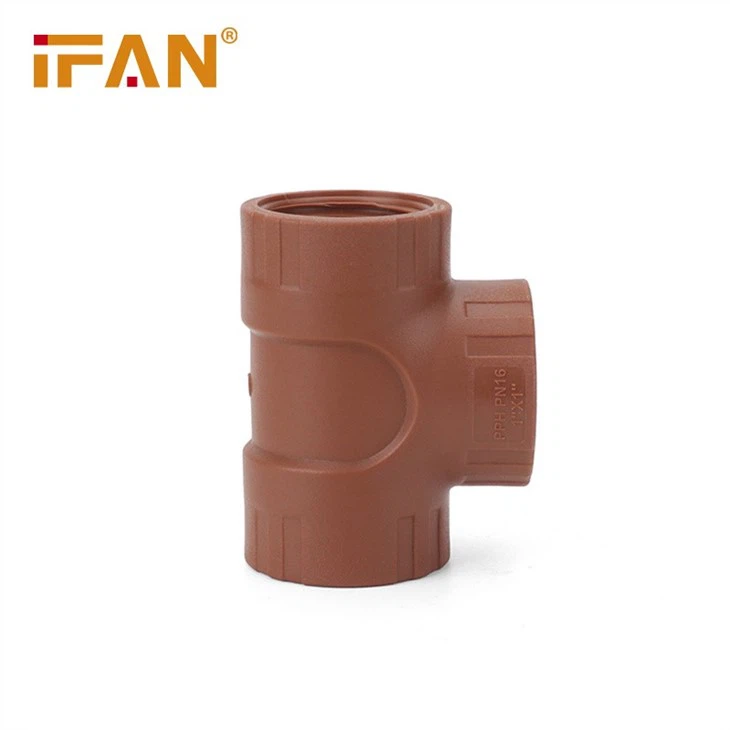
Customized Size PPH Plumbing Fittings
Brand: IFAN
Connecting method: Thread
Applications: Cold & Hot Water
Color: Red
Send Inquiry
Product Details ofCustomized Size PPH Plumbing Fittings
Introduct:
PPH (Polypropylene Homopolymer) fittings are durable plastic components used in various piping systems, particularly for transporting water, chemicals, and gases. Known for their lightweight nature and resistance to corrosion, PPH fittings are ideal for applications in industries like chemical processing, agriculture, and construction. They can withstand high temperatures and pressures, making them suitable for both hot and cold fluid transfer. PPH fittings are also easy to install and connect with various piping systems, providing a reliable and cost-effective solution for fluid management in diverse environments. Their long lifespan contributes to reduced maintenance costs.

| Product Name | PPH Pipe Fitting |
| Standard | EN ISO 15494,DIN 8077/8078,ASTM F2389,GB/T 19472 |
| Color | Red Brown or Customized |
| Size | 1/2-2" |
| Connection | Male/Female Thread |
| Sample | Free |
| Experience | 30+Years |
| Contact Us | Click HERE to contact us now! |

The Rheological Properties of PPH Fittings and Their Production Processes
The production of PPH (Polypropylene Homopolymer) fittings relies heavily on understanding their rheological properties, which describe how the material flows and deforms under applied stress. These properties significantly influence manufacturing processes such as injection molding and extrusion, directly affecting the quality and performance of the final products. This article explores the relationship between the rheological characteristics of PPH and various production techniques, highlighting the implications for manufacturers.
Understanding Rheological Properties
Rheology is the study of the flow and deformation of materials, particularly how they respond to applied forces. For PPH fittings, key rheological properties include viscosity, elasticity, and shear-thinning behavior. Viscosity refers to the resistance of the material to flow; higher viscosity can complicate the manufacturing process, while lower viscosity is typically preferred for easier processing. Elasticity describes the ability of the material to return to its original shape after deformation. Shear-thinning behavior, where viscosity decreases with increasing shear rate, is particularly beneficial during processing, as it allows for easier flow when the material is subjected to high shear forces in machines. Understanding these properties is essential for optimizing production methods.
Influence of Production Processes on Rheology
The production processes used for creating PPH fittings, such as injection molding and extrusion, significantly impact the material's rheological properties. During injection molding, the rapid injection of molten PPH into molds creates high shear conditions that can alter the viscosity and flow characteristics of the material. In contrast, during extrusion, the continuous flow of PPH through a die also impacts its rheological behavior, particularly as temperature and pressure vary. Manufacturers must carefully monitor these conditions to ensure that the material retains the desired flow properties throughout processing. Optimizing processing parameters based on the rheological characteristics of PPH can lead to improved product quality and consistency.
Effects of Temperature and Shear Rate
Temperature and shear rate are critical factors influencing the rheological behavior of PPH during manufacturing. As temperature increases, the viscosity of PPH typically decreases, making it easier to process. However, excessive heat can lead to thermal degradation, negatively impacting the material's mechanical properties. Shear rate, the rate at which the material is deformed, also affects viscosity; higher shear rates generally lead to lower viscosity due to shear-thinning behavior. Understanding the interplay between temperature, shear rate, and rheology allows manufacturers to fine-tune processing conditions for optimal results, ensuring that PPH fittings are produced with the necessary flow characteristics while avoiding potential quality issues.
Quality Control and Rheological Testing
Implementing rigorous quality control measures is essential for ensuring that the rheological properties of PPH fittings meet industry standards. Rheological testing involves measuring viscosity, elasticity, and flow behavior under different conditions to provide insights into material performance. This testing is crucial at various stages of production, from raw material selection to final product evaluation. By employing advanced rheometers and other analytical tools, manufacturers can identify deviations from desired specifications early in the process, allowing for adjustments to be made. Effective quality control not only enhances product performance but also reduces waste and improves overall production efficiency.


Hot Tags: customized size pph plumbing fittings, China customized size pph plumbing fittings manufacturers, suppliers, factory, PPH Reduce Socket, PPH Socket Fitting, PPH Female and Male Socket, PPH Male Threaded Plug, PPH Female Reduce Elbow, PPH Female Tee
Previous
No InformationSend Inquiry
